
A weighted 128 Hz tuning fork is one of the most common impulse buys in the wellness aisle. It gets struck once at a festival or a sound bath, feels briefly remarkable, and then lands in a drawer next to a selenite wand and a half-burned palo santo stick. The reason isn’t that the fork failed. It’s that nobody explained what the number stamped on the metal actually measures, or what to do with the thing on a Tuesday night at home. That gap is the whole problem with tuning forks healing frequencies as a search topic: the hertz value gets sold as a switch, and the physics, the tradition, and the nervous-system effects all get collapsed into one fuzzy promise. Here’s the honest version. The hertz value describes pitch, nothing more, and the relaxation most people feel comes from volume, distance, breath, and ritual far more than from any specific frequency. Once you know that, a tuning fork becomes a genuinely useful addition to a yoga practice instead of a dusty festival souvenir.
What the Hertz Number on a Tuning Fork Actually Measures
A fork stamped 128 Hz vibrates 128 times per second. That is the entire claim the stamp makes. Hertz measures cycles per second of the fundamental tone, which is a description of pitch, not an encoded medical or emotional outcome. A 4096 Hz fork is simply a higher pitch than a 128 Hz fork, the same way a piccolo sits above a cello. BioSonics’ own frequency guide makes the point directly: assigning a health outcome to a frequency does not establish that the frequency produces that outcome.
That is why this article treats tuning forks healing frequencies as a study in acoustics first and tradition second. The instrument is a precision piece of metal that rings at a known rate. What you build around that ringing (breath, attention, setting, the length of your session) is where any felt benefit actually lives. The frequency gives you a consistent, repeatable tone to work with. It does not give you a prescription.
Pitch, Loudness, and the Variables That Move the Experience
Frequency and amplitude are different things, and most wellness content blurs them. Frequency is the pitch. Amplitude is how loud it gets at a given distance. Strike the same 128 Hz fork hard two inches from your ear and you get a sharp, attention-grabbing tone. Strike it softly at arm’s length and you get a soft hum that melts into the room. Same fork, same number, two completely different experiences.
Distance and duration matter just as much. A tone held for ten seconds barely registers. A tone sustained for three minutes, with a slow breath underneath it, starts to pull your attention inward. The National Institute on Deafness and Other Communication Disorders frames hearing risk around loudness and exposure time, which is the right frame here too. Your ears care about volume and how long you’re exposed to it. The hertz figure on the fork is not the safety variable people assume it is.
Why the Number Is Not a Prescription
Here is what a hertz value does not measure: chakra alignment, tissue repair, emotional release, organ function, or the state of your nervous system. The 528 Hz DNA-repair claim is the cleanest example of a marketing line that outran its evidence. No peer-reviewed study establishes that listening to or applying a 528 Hz fork repairs human DNA or treats disease, and the BioSonics guide explicitly cautions against the claim. That doesn’t mean the fork is a con. It means the label on a frequency chart is doing something different than you were told. It’s a symbol and a starting preference, not a lab result.
The History Behind Tuning Forks Healing Frequencies
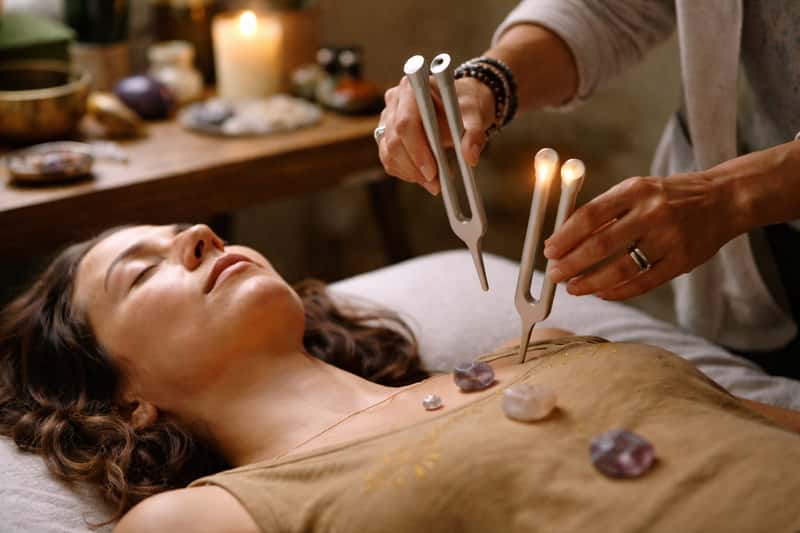
The tuning fork was invented in 1711 by John Shore, a British trumpeter, as a pitch-standardization device for musicians. That origin matters, because the fork spent its first century as a tool for making sure instruments agreed with each other, not for making anyone feel better. Its move into medicine came later, and it was entirely diagnostic. A PMC history of the instrument traces how 512 Hz became a clinical standard for hearing assessment and how 128 Hz became the standard for testing vibration sense in neurology. A neurologist taps a 128 Hz fork, presses it to your ankle, and asks whether you can feel the buzz. That’s a test for peripheral nerve function, not a healing session.
So when you see “128 Hz” on a sound-healing fork and “128 Hz” on a diagnostic fork, you are looking at the same number on two instruments built to do completely different things. No top-ranking page on tuning-fork frequencies makes this split, and it changes how you read every frequency chart you find afterward.
From Physics Lab to Wellness Studio
The Solfeggio scale is where the tradition gets its modern packaging. The six original tones (396, 417, 528, 639, 741, 852 Hz) surfaced through twentieth-century chant lore and were later expanded with 174, 285, and 963 Hz by wellness marketers. The 432 Hz versus 440 Hz debate has a similar shape: it’s a tuning-standard argument that got dressed up as a therapeutic one. If you want the energy-system context that usually gets paired with these tones, the site’s chakra frequencies guide walks through the assignments; this article is about what the fork itself is doing.
Diagnostic Forks Versus Sound-Healing Instruments
The practical difference is in how the fork is built and how it’s used. A diagnostic fork is calibrated for assessment, designed to be struck and held against a bony landmark while a clinician watches for a response. A sound-healing fork is chosen for body contact and sustained tone. Weighted forks hold their vibration longer and are built to be placed directly on the body. Unweighted forks ring cleaner and louder, and suit near-ear listening or filling a room. Both are tuning forks. Only one is a medical instrument.
An Evidence-Graded Tuning Fork Frequencies Chart

Every frequency chart you find online presents its numbers as established fact. Here is what the evidence actually supports, sorted into four tiers. “Established” means physics and audiology agree. “Plausible” means there’s a real mechanism and some supportive research, though not frequency-specific proof. “Traditional” means it comes from the Solfeggio and chakra systems, not from clinical trials. “Unsupported” means the claim doesn’t hold up.
| Frequency | Common Claim | Evidence Tier | What’s Actually True |
|---|---|---|---|
| 128 Hz | Grounding, vibration-sense testing | Established (diagnostic) / Plausible (relaxation) | Reliable tone for body contact and low-frequency vibration |
| 174 Hz | Pain relief, safety | Traditional | No clinical evidence for pain relief |
| 285 Hz | Tissue repair, energy field | Traditional | No mechanism or study supports tissue repair |
| 396 Hz | Releasing fear, guilt | Traditional | Rooted in Solfeggio lore, not trials |
| 432 Hz | Calmer than 440 Hz | Established (as a tuning preference) | A standard, not a therapy |
| 528 Hz | “DNA repair,” love, transformation | Plausible (calm) / Unsupported (DNA) | May support relaxation; DNA claim is unfounded |
| 639 Hz | Relationships, connection | Traditional | No frequency-specific evidence |
| 741 Hz | Detox, expression | Traditional | No frequency-specific evidence |
| 4096 Hz | Alerting close, clarity near the crown | Established (as high pitch) / Traditional (crown clarity) | Bright, attention-shifting tone; the crown association is lore, not a finding |
Reading the Four Evidence Tiers
Established covers what physics and audiology confirm: the fork vibrates at a known rate, the pitch is that rate, and loudness and exposure time drive hearing risk. Plausible covers relaxation and nervous-system effects with a real mechanism, like vagal response to gentle sternum vibration. Traditional covers chakra and Solfeggio assignments, which come from lineage and lore rather than experiments. Unsupported covers DNA repair, organ healing, and disease treatment. When you meet a new frequency claim, ask which tier it belongs in. That one question will save you a lot of money and a lot of confusion.
174 Hz Through 963 Hz, Labeled Honestly
Walking the common Solfeggio numbers: 174 Hz and 285 Hz are traditional, with no clinical backing for pain relief or tissue repair. 396 Hz is traditional, tied to fear and guilt release in the Solfeggio system. 432 Hz is a legitimate tuning-standard preference, which is a real thing, just not therapy. 528 Hz is plausible for calm and unsupported for DNA repair. 639 Hz and 741 Hz are traditional. The BioSonics caution applies across the board: assigning an outcome to a frequency does not establish the outcome. If you want to read what the complementary-health field says about that gap between wellness practice and medical treatment, the National Center for Complementary and Integrative Health keeps a plain-language overview worth bookmarking.
How Tuning Fork Sound Healing Might Work on the Body
There are three honest mechanisms worth naming, and none of them require a specific hertz value. Low-frequency vibration on the sternum may stimulate vagal afferents, the sensory fibers that feed back into the parasympathetic branch of your nervous system. That mechanism is plausible rather than proven for handheld forks specifically, and the broader finding that gentle mechanical vibration can influence autonomic tone comes largely from whole-body vibration and physiotherapy research rather than from tuning-fork trials. A sustained tone paired with slow breathing supports a parasympathetic downshift, which is the same response a long exhale produces in any yoga or pranayama practice. Focused attention on vibration sharpens interoceptive awareness, your felt sense of what’s happening inside your body. That third one is easy to dismiss, and it’s probably the biggest contributor to why people walk away from a session feeling different.
Vagal Tone, Breath, and the Parasympathetic Downshift
The relaxation stack is straightforward. Gentle vibration on the chest plus a slow exhale plus a sustained tone gives the nervous system three signals at once, and they all point toward “we’re safe, we can settle.” This is the same nervous-system framing the site uses elsewhere: it’s about creating conditions for downshift, not forcing an outcome. If you’ve read the somatic yoga coverage, this will feel familiar. The fork is just one more way to give the body a signal to slow down.
Interoception and the Attention Effect
Part of what you feel during a session comes from where your attention goes. You’re listening for the tone, tracking the buzz in your chest, noticing where it fades. That’s a body-scan with a soundtrack, and the body-scan is doing a lot of the work. This is also why blinding in tuning-fork research is nearly impossible. Participants can hear and feel the intervention, so researchers can’t cleanly separate the fork’s effect from expectation, touch, and relaxation. Small studies report improvements in pain or quality of life, but those results carry a big asterisk. The ritual and setting matter. So does the fact that you decided to do something for your nervous system.
Research Translation Warnings
Two warnings that every sound-healing article should carry and almost none do. Music therapy research does not transfer directly to a handheld tuning fork. Different delivery, different dose, different population. Research on 40 Hz sensory stimulation, often used in Alzheimer’s and cognitive studies, is not evidence for a 40 Hz fork, and it isn’t evidence for any other frequency fork either. When someone cites a study to sell you a fork, check whether the study used a fork. Most don’t.
Weighted Versus Unweighted Tuning Forks and the Kit to Start With

Weighted forks hold their vibration longer and are built for direct body contact. The weighted prongs let you press the base against your sternum, your palm, or a muscle belly and feel the buzz travel. Unweighted forks ring cleaner and louder, with a purer tone that carries further. They’re the right tool for near-ear listening and for filling a room during savasana. Neither is better. They do different jobs, the same way a mallet and a brush do different jobs.
Matching the Fork to the Job
For most people starting out, two forks cover almost everything. A weighted 128 Hz is your grounding and body-contact fork, the one you’ll place on the sternum or the soles of the feet. An unweighted 4096 Hz is your alerting fork, bright and clean, for a near-crown close that shifts the room’s attention upward. If you want a mid-range unweighted fork for meditation, 528 Hz is the most common pick, and 432 Hz is the most common alternative. Use the tuning fork frequencies chart above as a reference for what each number does and does not claim, not as a promise sheet.
What a Starter Set Costs and When It Is Worth It
A single weighted fork runs roughly $30 to $60. A pair, one weighted and one unweighted, usually lands between $60 and $120 depending on brand and finish. Do the honest math before you buy. If you already practice four or five times a week, a $90 pair that becomes part of your savasana is about $1.50 per week over a year. If you practice twice a month, the same pair costs you around $3.75 each time you use it. That framing is worth applying to any practice investment, and the site’s savings yoga piece walks through the same budgeting logic.
How to Use Tuning Forks on the Body Safely
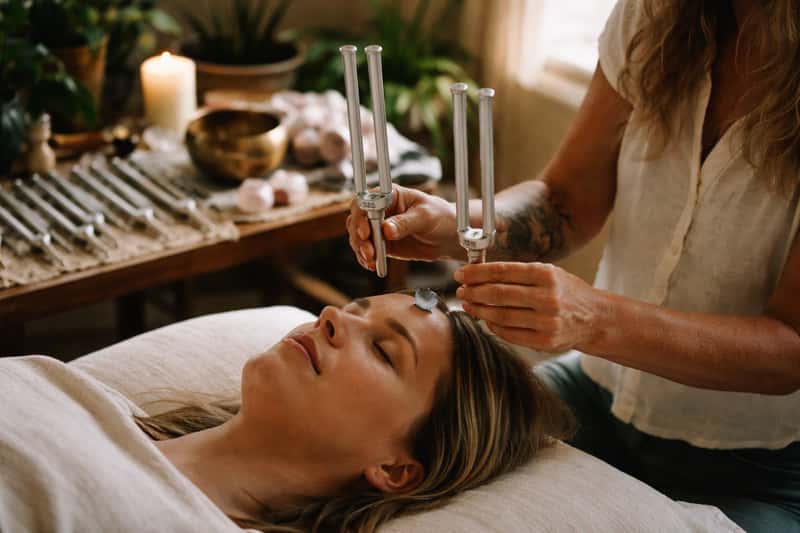
The general safety picture is favorable. Tuning forks are low-risk when used gently and correctly. The concerns that do come up are practical ones: excessive volume, prolonged exposure, forceful contact with vulnerable areas, and use near implanted electronic devices. Every published safety note on the subject converges on that same short list. None of it is exotic. It’s the same set of cautions you’d apply to any handheld vibration tool.
Contraindications and Who Should Skip It
Skip tuning fork work if you have tinnitus, hyperacusis, or sound sensitivity, or check with an audiologist first. Skip anything near the chest if you have a pacemaker or another implanted electronic device. Skip it during pregnancy unless your provider clears it. Skip it over healing fractures, recent joint replacements, areas affected by osteoporosis, and anywhere you’ve had recent surgery. And skip the neck, throat, and base of the skull entirely. Those areas are dense with sensitive structures and have no business receiving direct vibration from a metal fork. This is not a list that should scare you. It’s a list that should make you a more intelligent user.
Volume, Distance, and Session Length
Hearing safety tracks loudness and exposure time, not frequency. Never strike a fork beside your ear, or anyone else’s. Keep the tone at a comfortable level, which usually means holding the fork at least a foot from the ear for near-ear listening. Take breaks between tones rather than stacking them. Short sessions, five to fifteen minutes, are plenty. If you notice ringing, muffled hearing, or pressure in your ears after a session, stop and give your ears a rest.
Where Sound Healing Stops and Medical Care Begins
A tuning fork is a complementary wellness tool. It is not a substitute for diagnosis or treatment, and no frequency on any chart is a treatment for a medical condition. If you’re dealing with chronic pain, anxiety, depression, sleep disorders, or anything diagnosed, the fork can sit alongside your care, never in place of it. PubMed has the peer-reviewed work if you want to read it yourself, and NCCIH publishes plain-language summaries of what the evidence does and does not support.
A Beginner Protocol for Relaxation and Body Awareness
Here is the session you can run tonight. Ten to fifteen minutes, bolted onto the end of an existing yoga practice. It is a relaxation and body-awareness practice. It is not a treatment for anything, and you don’t need one to benefit from it.
The Ten-Minute Sequence, Step by Step
- Settle into a comfortable seat or lie down in savasana. Let your arms rest away from your body.
- Take three slow breaths, exhaling longer than you inhale. Three or four counts in, six or eight counts out.
- Strike the weighted 128 Hz fork against the palm of your hand or a rubber puck. Never against a hard surface.
- Place the base of the fork gently on your sternum. Keep the prongs off your skin if the buzz feels sharp.
- Hold it there for two to three minutes, pairing the tone with a long exhale each time it fades. Re-strike as needed.
- Move to a second placement: the palm of your hand, the sole of your foot, or the outer thigh. Two minutes.
- Pick up the unweighted 4096 Hz fork and hold it about a foot from the crown of your head, off the skull, for one minute. This is the alerting close.
- Set both forks down and stay in silence for two minutes before you move.
Breath Cues and a Closing Savasana
The breath is doing half the work. Pair each tone with a slow exhale count, and let the inhale be shorter. If you lose the rhythm, drop the fork and find your breath again before re-striking. The final two minutes of silence matter as much as the tones. That’s when the nervous system integrates the shift, and it’s the same closing beat the site recommends in its somatic yoga practice for readers who want the full body-scan version.
How Often to Practice and What to Track
Three to five sessions a week for the first month is a reasonable cadence. Longer isn’t better. Keep a simple log: session length, placement, and one sentence about how you felt afterward. Over four weeks you’ll have about twenty data points, and patterns will start to show up. Maybe sternum placement always makes you sleepy. Maybe 4096 Hz near the crown leaves you wired at night. That log is what turns the practice from a curious ritual into a body-awareness tool.
Choosing Your First Frequency Without the Hype
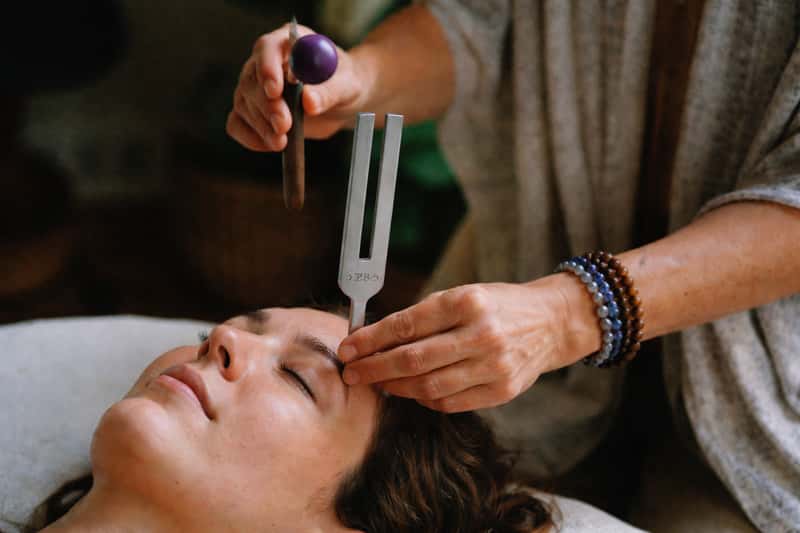
The decision rule is simple. Pick a fork you enjoy listening to at a comfortable volume, because the evidence supports relaxation and attention, not frequency-specific cures. If you like the way 528 Hz sounds, buy 528 Hz. If 432 Hz feels warmer to your ear, buy 432 Hz. Both are popular starting points with symbolic value rather than proven value. Your preference is a legitimate reason to choose, and it’s the reason that will keep you actually using the thing.
Buying, Cleaning, and Storing Your Fork
Look for steel or aluminum alloy with a clean finish and a stated tolerance, usually within a few cents of the target frequency. Store it in a soft pouch or case to protect the prongs, since a bent prong detunes the fork. Clean it with a soft cloth and a little isopropyl alcohol on the base only, never submerge it, and never strike it against metal or stone. A fork cared for this way will hold its pitch for years.
Where Tuning Forks Fit Alongside Crystals and Other Energy Tools
Both tuning forks and crystals belong to the same energy-work toolkit, but they operate differently. A fork acts through sound and vibration you can hear and feel. A crystal is used as a placement prop, sitting on or near the body. If you’re building a mixed practice and want to understand how the two modalities differ in intent and use, the site’s throat chakra crystals article walks through the crystal side of that toolkit. One note for the teacher-track readers who found this page: this is a practitioner frequency piece, not a revenue playbook. The yoga business plan guide covers the other side if that’s what you came for.
Our Read
The number on the fork is not a switch. It’s a pitch, and the practice around it is what does the work. Breath, attention, setting, and volume carry the felt experience, and the fork gives you a clean, repeatable tone to hang them on. Start with a weighted 128 Hz and an unweighted 4096 Hz, run the ten-minute session three to five times a week for the first month, and keep a short log. That’s the whole experiment, and it’s a better one than chasing a frequency chart that promised more than any metal fork can deliver.
FAQs about tuning forks healing frequencies
How long should a tuning fork session last for a beginner?
Ten to fifteen minutes is plenty. The beginner protocol in this article runs about ten minutes of active work plus two minutes of closing silence. Longer sessions don’t produce proportionally more benefit and they do increase your total sound exposure, so keep it short and repeatable.
How many times a week should I use tuning forks for healing frequencies?
Three to five sessions a week for the first month is a reasonable starting cadence. This is enough to notice patterns in how you respond without turning the practice into a chore. After the first month, adjust based on what your log shows.
What’s the best tuning fork frequency for healing anxiety?
No frequency is a treatment for anxiety, and there’s no frequency-specific evidence for anxiety relief. What does have a plausible mechanism is the relaxation response itself: gentle low-frequency vibration on the sternum paired with a slow, extended exhale, the same downshift any pranayama practice produces. If anxiety is affecting your daily life, the fork can sit alongside your care, never in place of it.
Is a 528 Hz tuning fork really a DNA repair fork?
No. The DNA-repair claim is a marketing line with no peer-reviewed backing. 528 Hz may support relaxation like any pleasant sustained tone, which lands it in the plausible tier for calm and the unsupported tier for DNA.
What’s the difference between weighted and unweighted tuning forks?
Weighted forks hold their vibration longer and are built for direct contact with the body. Unweighted forks ring cleaner and louder and suit near-ear listening or room-filling work. Most starters end up wanting one of each rather than choosing between them.
Is 432 Hz better than 440 Hz for meditation?
Neither is better for meditation. 432 Hz versus 440 Hz is a tuning-standard preference, not a therapeutic distinction. Pick the one that sounds more pleasant to you at a comfortable volume. Your preference is a valid reason.
Can I use tuning forks on my neck or skull?
No. Skip the neck, throat, and base of the skull entirely. Those areas are dense with sensitive structures, and direct vibration from a metal fork has no place there. Sternum, palms, soles of the feet, and outer limbs are the safe contact points.
Can I use tuning forks if I have tinnitus or a pacemaker?
Skip tuning fork work if you have tinnitus or hyperacusis, and skip anything near the chest if you have a pacemaker or another implanted electronic device. Check with your audiologist or physician first. The cautions in the safety section above cover the full list.
How far should a tuning fork be from my ear?
At least a foot for near-ear listening, and never strike a fork beside your ear or anyone else’s. Hearing risk tracks loudness and exposure time, not frequency. If you notice ringing or muffled hearing after a session, stop and rest your ears.
Do I need a different tuning fork for each chakra?
No. The chakra-to-frequency assignments are traditional, not experimental, so there’s no clinical reason to buy a full set. If the traditional mapping matters to your practice, the site’s chakra frequencies guide maps the assignments. Otherwise, one weighted and one unweighted fork cover almost everything.