
A teacher charges $25 for a 75-minute class she preps for an hour, then drives 30 minutes each way to teach. Subtract the gas, the props, the unpaid sequencing time, and her effective rate is closer to a fast-food shift. That gap is why 48% of yoga professionals name low pay and financial instability as a major career challenge (Yoga Alliance, 2023). The fix isn’t a “charge your worth” mantra. The fix is arithmetic, and learning how to price yoga classes starts with knowing the exact dollar floor below which every class you teach loses you money.
Why Yoga Teachers Undercharge (And What It Costs You)
Half the profession is quietly going broke. That 48% figure from the 2023 Yoga Alliance report isn’t about greedy teachers refusing to share the gift. It’s about guilt and guesswork. You picked a number that felt polite, the studio handed you a flat rate, and nobody ever ran the math on whether either one keeps the lights on. Underpricing isn’t humility. It’s a slow exit from the work you trained for. The rest of this guide is a numbers-first repair, not a pep talk.
The “Yoga Should Be Free” Trap
Somewhere in your training you absorbed the idea that charging well betrays the practice. Ancient teachers didn’t take Venmo, so who are you to send an invoice? Run that through ahimsa instead. Non-harming includes you. A teacher who undercharges until she burns out and quits harms every student who relied on her. Sustainable pricing is how the practice survives long enough to reach anyone.
What Students Pay vs. What Teachers Keep
Most guides blur the line that matters most. The average US group class runs $15 to $25 (Lessons.com), but studios often pay teachers a flat $25 to $50 per class, sometimes with a small bonus, say $2 to $5 per head, above a threshold like ten students. So the $22 a student swipes is not your money. Your take-home depends entirely on whether you own the rate or rent the room. That distinction decides everything downstream.
Start With Your Numbers, Not the Competition

Nearly every pricing article tells you to scout competitors first. Flip it. Small-business break-even logic says you calculate your own minimum sustainable rate before you ever look at the studio down the street. This changes the question from “what will people pay me” to “what do I need to charge to keep teaching at all.” Sometimes the honest answer is that single-studio drop-ins alone can’t fund your life, and you need to know that before you set a price, not after a year of resentment.
Work Backward From Your Income Goal
Pick a target. Say you want $55,000 after tax. Add roughly 25% for self-employment tax and overhead, and you need about $69,000 gross. Divide by 48 working weeks and you need around $1,440 a week. If you can realistically teach and bill 18 hours a week, that’s an $80 hourly baseline. Not a wish. A floor.
Counting Billable Hours Honestly
Here’s where the $80 erodes. A single 60-minute class isn’t one hour of work. Add 45 minutes of sequencing, 60 minutes of round-trip travel, and 15 minutes of admin, and that $60 class ate three hours. Your effective rate just dropped to $20. Count the hours around the mat or your baseline is a fiction.
Your True Cost Per Class
Below a certain dollar figure, you pay to teach. Sibling business guides skip this part. You won’t. Splitting your costs into fixed and variable gives you a hard floor, and once you have it, no studio offer and no guilt trip can talk you below it.
Fixed Costs That Run Whether You Teach or Not
Liability insurance runs roughly $150 to $300 a year. Scheduling software might be $30 a month. Continuing education and certification renewals add a few hundred annually. Tally those, divide by your monthly class count. If your fixed costs total $200 a month and you teach 40 classes, that’s $5 baked into every single class before anyone shows up.
Variable Costs Per Session
These move with each class. Room hire might be $20, travel $6 in gas, props and laundry $2, payment processing roughly 3% of revenue. Add it up and a typical independent class might carry $28 to $35 in real cost before you earn a cent. The break-even number stops being abstract the moment you total it. The U.S. Small Business Administration’s break-even worksheet applies cleanly to a yoga schedule.
Your Break-Even Student Count
Now combine them. Say fixed share is $5, variable cost is $30, and you charge $22 a head. Each student nets you $22, but you owe $35 in cost. You need two students just to clear costs, and to hit a $40 profit target you need four paying students per class. Below that, you’re subsidizing the room.
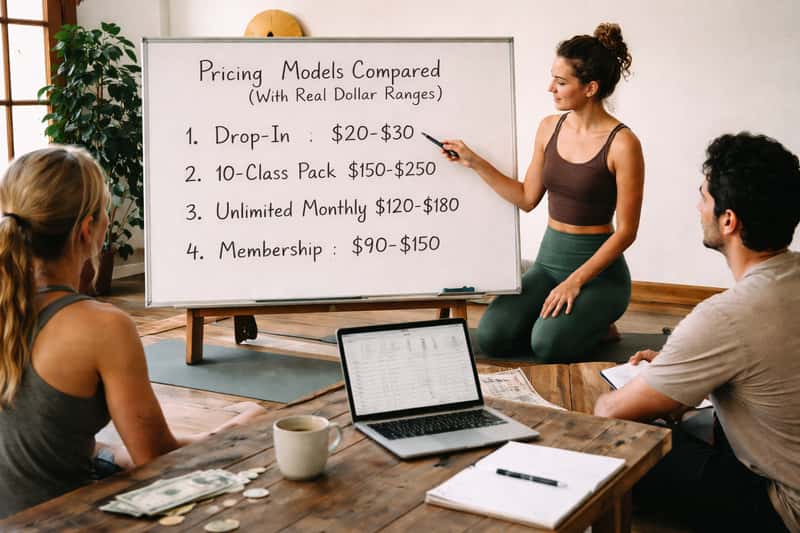
Pricing Models Compared (With Real Dollar Ranges)

There’s no single right price, only structures that fit different goals. Here’s the model menu, anchored to numbers calibrated for a mid-size US city. Match the structure to the cash-flow problem you actually have.
| Model | Example price | Best when |
|---|---|---|
| Drop-in | $22 single | Casual students, low commitment |
| 4-class intro pack | $72 ($18/class) | Converting newcomers to regulars |
| 10-class pass | $180 ($18/class) | Rewarding loyalty, front-loading cash |
| Unlimited monthly | $130-$160 | Frequent students, predictable revenue |
| Private 1:1 | $70-$150/hour | High-touch, fastest per-hour income |
| Semi-private (3-5) | $40-$60 each | Small-group economics that beat group rates |
Drop-In vs. Class Packs
A $22 single drop-in is your highest per-class price and your least reliable revenue. A 4-session intro pack at $72 drops the per-class cost to $18 but gets cash in your account up front and gives a newcomer four reasons to return. Packs trade a little margin for retention and cash flow, which is usually the better deal.
Memberships and Unlimited Models
An unlimited membership at $140 a month is genius or a leak depending on attendance. A student who comes twice a week pays you about $16 a class, fine if your costs are covered by volume. The membership wins when it converts sporadic drop-ins into predictable monthly income. It loses when you hand frequent students a steep discount you didn’t model. Run the per-visit math before you launch one.
Private and Semi-Private Sessions
One-on-one work commands $70 to $150 an hour in the US (Lessons.com), the fastest path to your income goal. Semi-privates stack the economics: three to five people at $40 to $60 each puts $120 to $300 in your pocket for one hour. Privates carry your income when group classes are thin. They drain you when they swallow a calendar you can’t scale.
Anchoring Your Price to Your Local Market
Now you bring in the competition, but as a sanity check, not a starting line. You already know your minimum sustainable rate. Local research tells you whether the market clears it, and where you have room above it. Price against benchmarks, not feelings.
How to Research Local Rates Without Guessing
Open five nearby studio websites and write down their listed drop-in, pack, and membership prices. Check booking platforms for the same. Note the spread across your city. Big-city boutique classes hit $30 to $35 (YogaKali), while rural markets sit well below that. If your minimum rate lands above what every local studio charges, that’s a signal to shift toward privates or specialization, not to slash your price.
Adjusting for Specialization and Format
A general drop-in is the floor; specialized work sits above it. Therapeutic, prenatal, trauma-sensitive, and corporate classes command premium rates because they require training most teachers don’t have. Online classes generally price below in-person because overhead is lower, but a hybrid offering, livestream plus on-demand plus in-studio, stabilizes revenue across formats. Price from the outcome, not the clock.
Specialized and Accessible Pricing Done Right
Keeping yoga reachable is real ahimsa. Training students to wait for the next sale is not. The line between a sustainable accessibility model and a quiet race to the bottom is whether your base rate survives it.
Building a Sliding Scale With a True-Cost Anchor
A real sliding scale states the actual cost of running the class so students choose honestly. You might post: “This class costs $20 to deliver; pay $15, $20, or $30 based on your means.” That transparency lets people who can pay more do so, and people with less still attend, without you absorbing the entire gap silently. Accessible-pricing thinking balances reach with the teacher staying solvent.
Discounts That Don’t Train Students to Wait
A perpetual 20% promo teaches everyone that your real price is the sale price. Limited works better. Hold a few community slots per class, offer a handful of need-based scholarships, run an intro pack that expires. These are occasional access points, not a permanent discount that quietly erodes the base rate your whole income sits on.
How to Raise Your Rates Without Losing Students
Most teachers know they undercharge. They freeze at the conversation. The fear is that one email empties the room. It rarely does. What loses students is a clumsy, apologetic, over-justified increase. Timing, a script, and the nerve to hold the line solve it.
When and How Much to Increase
Wellness businesses raise prices in modest 5% to 15% bumps to protect margins against rising rent and costs (Mindbody, 2024). A $22 drop-in becoming $24 is barely felt. Give 30 days notice. You can grandfather long-term students at the old rate for a set window, or phase the new rate in for everyone at once. Pick one and commit; mixed messaging invites negotiation.
Scripts for the Conversation
For email: “Starting next month, drop-in classes will be $24 and the 10-class pass $200. This keeps my schedule consistent and my classes the quality you’ve come to expect. Your current pass stays valid at today’s rate.” For the in-person “why the increase,” say: “Costs went up and I’d rather raise prices a little than cut what I offer.” No apology. No paragraph of justification. State it like the businessperson you are.
Where Pricing Fits in the Bigger Business Picture

Class rates are one line item, not the whole ledger. Pricing decides what you charge; a full plan decides whether the whole operation holds together. Readers who want the complete operational view, from budgeting to income mapping beyond per-class math, should move from rates to the full picture in the yoga business plan guide.
Tracking Revenue and Staying Legal
Track every dollar in a simple spreadsheet from day one. Check whether your state taxes yoga instruction; some do. A sole proprietorship is simplest to start, while an LLC adds liability protection worth discussing once revenue grows. Use written contracts for private and corporate clients so scope and payment are clear. For anything tax or structure specific, pay a few hundred dollars for an hour with a professional. It’s cheaper than the mistake.
The YogiPreneur Take
Pricing isn’t a confidence exercise, it’s a math problem with a self-respect attached. Run your minimum rate, build the models that fit your life, and say your number without flinching. A teacher who stays solvent is a teacher who’s still on the mat next year, and that’s the most generous thing you can offer.
FAQs about how to price yoga classes
How much should I charge for a yoga class as a new teacher?
Start with your minimum sustainable rate from your income goal and costs, then anchor to local benchmarks. In most US markets a new teacher’s group drop-in lands around $15 to $22, with packs slightly lower per class.
How do you price private yoga sessions versus group classes?
Private sessions price by the hour at $70 to $150 in the US because they’re high-touch and don’t scale. Group classes price per student, so your income depends on filling the room, not the headline rate.
What is the average cost of a yoga class in the U.S.?
The average group class runs $15 to $25 per session, with big-city boutique studios reaching $30 to $35 and rural markets sitting lower. Packs and memberships reduce the effective per-class cost.
How do I price yoga classes in a small town versus a big city?
Research what nearby studios actually charge, since rural rates sit well below the $30-plus boutique pricing of major cities. If local rates can’t meet your minimum, shift toward privates, specialization, or online students.
Should I offer donation-based or pay-what-you-can yoga classes?
Only with a stated true-cost anchor so students choose honestly and you don’t absorb the whole gap. Use limited community or sliding-scale slots rather than making every class donation-based, which rarely covers your costs.
How do I raise my yoga prices without losing students?
Give 30 days notice, raise modestly in the 5% to 15% range, and use a short script that states the increase without apologizing. Most students stay; the ones who leave were rarely your core revenue.
How do I price online yoga classes compared to in-person?
Online classes generally price below in-person because your overhead, room hire, travel, and props, drops. A hybrid model that bundles livestream, on-demand, and in-studio access stabilizes revenue across formats.
How do I calculate my minimum rate as a yoga teacher?
Take your target after-tax income, add roughly 25% for taxes and overhead, then divide by your realistic billable teaching hours per year. That baseline hourly number is the floor every offering should clear.
How many students do I need per class to break even?
Add your per-class fixed share and variable costs, then divide by your per-head rate. If costs total $35 and you charge $22, you need two students to break even and about four to hit a healthy profit.
What’s the best way to structure memberships and class packs?
Model the per-visit math first. Price packs slightly below drop-in to reward commitment and improve cash flow, and only launch an unlimited membership once you confirm frequent attendees won’t shrink your effective rate below your floor.